The HSE (Health and Safety Executive) states that flour dust and enzymes containing additives such as amylase are the second most common cause of occupational asthma in the UK and, as such, must be effectively controlled under COSHH (Control of Substances Hazardous to Health) Regulations 2002.
As well as occupational asthma, dust that is produced as a result of food production, can also cause serious skin conditions including dermatitis.
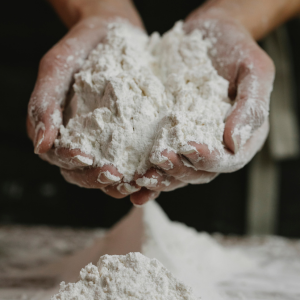
Dustcheck's UK manufactured dust collectors and sack tipping stations are widely used in bakeries and commercial kitchens to effectively control airborne flour dust particles.
Tasks where exposure to flour dust and/or enzymes may occur include:
- Adding ingredients to hoppers containing flour by hand
- Maintenance to machinery where flour is used or to equipment where flour dust has settled
- Filling equipment from bags/sacks containing flour and disposing of the bags
- Weighing and mixing processes
- Using dough brake roll machines
- Cleaning tasks in work places where flour is used
Workplace Exposure Limits (WELs)
A wide range of substances have long term 'Workplace Exposure Limits' (WELs) - a full list can be found by downloading HSE publication EH40.
The concentration of a hazardous substance in the air is averaged over a reference period, usually 8 hours, and is known as a time weighted average or TWA. The WEL for flour dust is 10 milligrams per cubic metre of air (mg/m3), measured as an 8 hour TWA – not an absolute. A higher limit, 30mg/m3, averaged over a 15 minute period, is recommended for short term high level exposure.
Legally, employees must not be exposed to levels above that limit and if exposure cannot be eliminated, it must be reduced to a level which is 'as low as is reasonably practicable' (ALARP) below the WEL.
Dust Control Equipment
If exposure to flour dust is identified as a risk, it is essential that a fit for purpose dust extraction LEV system is installed. Engineering controls such as LEV systems are a higher priority than PPE in the hierarchy of controls - PPE is a last resort as it only protects the employee using it.
Dustcheck's dust extraction experts design and build dust control and air filtration equipment including products which are especially developed to meet the European Hygienic Engineering & Design Group (EHEDG) hygiene requirements of the food industry and Good Manufacturing Practice (GMP) in the food industry.
Standards of construction vary from mild steel with standard or special paint finishes, to stainless steel (grade to suit ie. 304 or 316) with finishes from standard sheet with welds as laid, to special crack and crevice free polished finishes – ideal for food production purposes.
Explosion Risk
Substances regularly used in the food industry, including flour, sugar and starches and various other organic ingredients, all have the potential to explode.
Manufacturing processes and equipment can create a ‘dust cloud’. When this cloud is suspended and mixed with air and exposed to an ignition source it can cause catastrophic, even fatal, explosions.
All Dustcheck dust collectors come with ATEX rated options meaning potentially explosive and volatile products such as flour dust, can be handled safely in accordance with Dangerous Substances and Explosive Atmospheres Regulations (DSEAR).
Contact our team today by calling 01952 290500 or filling in this short contact form and one of our dust experts will be in touch.