You might not think that icing sugar or custard powder is a hazard, yet history shows that under the right conditions a range of everyday food ingredients can ignite and explode with the same destructive force as industrial chemicals.
Dustcheck’s dust extraction experts work closely with customers in the food and beverage industry to ensure potentially explosive food dusts are effectively controlled and all risks minimised.
When dust turns dangerous
Some of the most devastating industrial explosions on record began with a cloud of fine food dust suspended in the air.

In 2008, an explosion at the Imperial Sugar Refinery in Georgia, USA claimed 14 lives. In 1979 a blast tore through the Roland Mill in Bremen, Germany, also killing 14 employees. And in 1981 an explosion at the Bird's Custard factory in Oxfordshire in the UK left nine people injured.
Different countries, different decades, different ingredients - yet each incident shares the same root cause: fine combustible dust, the right concentration in the air, and an ignition source.
Measuring the risk: the GESTIS-DUST-EX database
To understand and prevent these hazards, safety professionals can turn to the GESTIS-DUST-EX database, which catalogues the combustion and explosion characteristics of more than 7,000 dust samples from virtually every industrial sector. This data forms the basis for the safe handling of combustible dusts for planning preventive and protective measures in a diverse variety of food production facilities.
At the heart of the database is an internationally used classification system that ranks dust combustibility by St class, based on a value known as Kst - a measure of how violently a dust cloud can explode:
- St 1 – Kst 1–200 bar·m/s - weak to moderate explosion
- St 2 – Kst 201–300 bar·m/s - strong explosion
- St 3 – Kst above 300 bar·m/s - very strong explosion
Seven ingredients, one hidden hazard
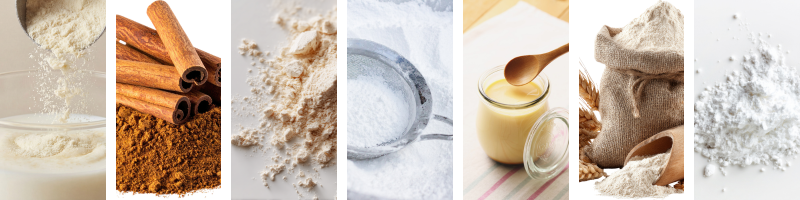
According to GESTIS-DUST-EX database, several everyday food ingredients can reach St 2 or higher in dust form, making them highly combustible. These include:
- Maize/corn starch
- Wheat starch
- Dextrose/glucose
- Powdered sugar
- Flour
- Milk powder
- Cinnamon
These are all staple ingredients commonly found in bakeries, mills, and food processing plants throughout the UK.
Why the Kst value matters for compliance
The Safety Data Sheet (SDS) provided by an ingredient manufacturer should state the Kst value for that material. This is essential information that must be shared with any equipment supplier, including Dustcheck, tasked with meeting DSEAR regulations and complying with the ATEX Directives. Without it, a business risks specifying extraction or filtration equipment that isn't suitable for the explosion hazard which is actually present on site.
For further guidance on preventing dust explosions in food manufacturing, visit the HSE website.
Dustcheck provides a wide variety of dust collectors and vessel venting filters used in food production facilities which can all be supplied to conform with DSEAR and COSHH Regulations.
As part of Filtermist Limited, Dustcheck can also provide access to Filtermist’s projects team which specifies, designs, installs, and commissions large scale centralised LEV extraction systems capable of collecting dust-laden air from multiple pick-up points in food processing plants.
Our dust experts would be happy to discuss any extraction requirements you may have - fill in this short form and a member of our team will be in touch.